A Rail-Replacement Bus for Justice: The Case Against the CCBD
By Jared · Nov 27, 2025
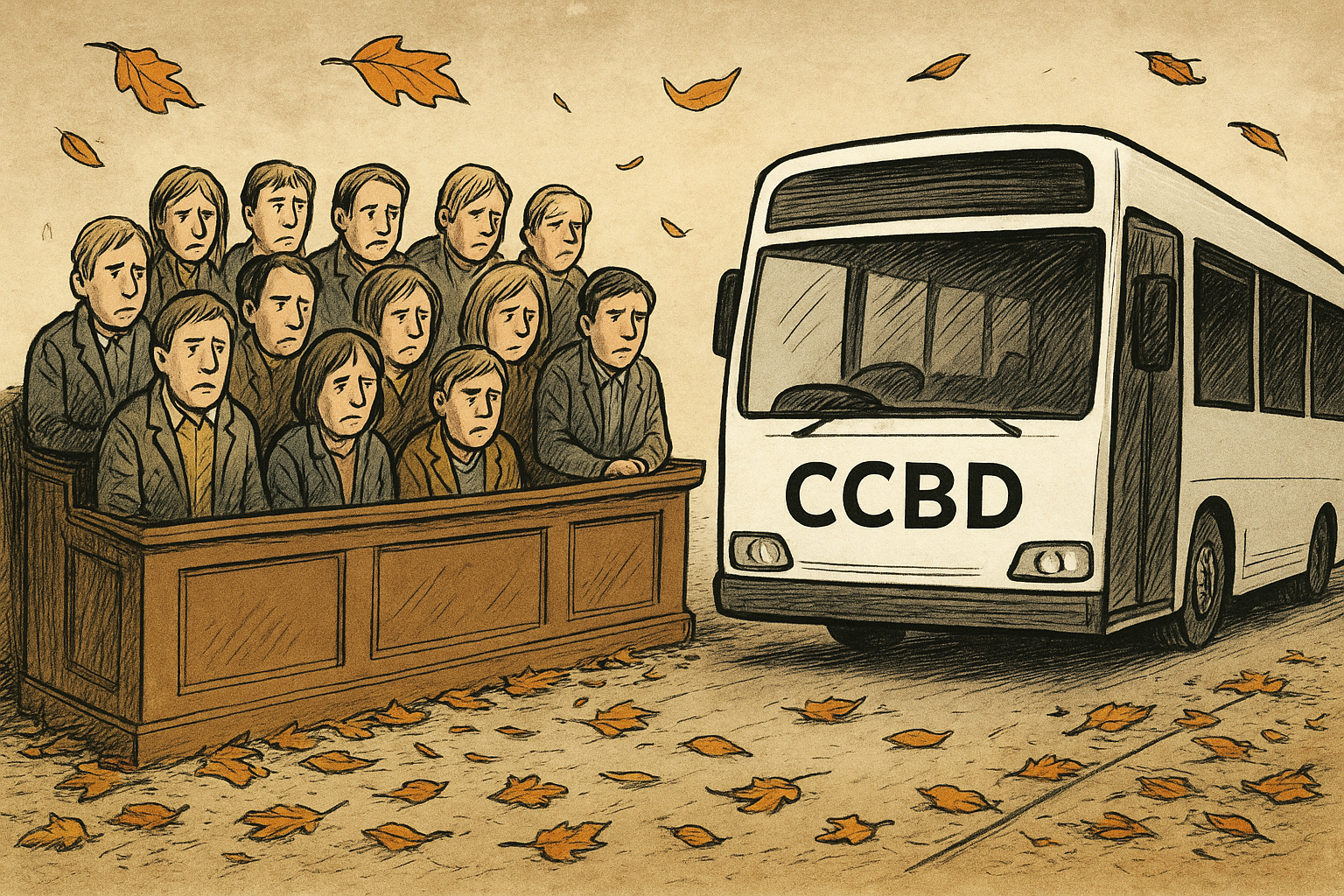
“No doubt the next target will be the jury, ‘a luxury we can no longer afford’" – Jeremy Hutchinson QC, 2016
UK lawyers are outraged by the Justice Secretary’s proposal to restrict the right to trial by jury. According to a spokesperson for the Ministry of Justice, the aim is to tackle the swelling backlog - currently around 78,000 criminal cases waiting to be heard - and that “bold action” is needed to set this straight. But criminal barristers are unconvinced. Riel Karmy-Jones KC, chair of the Criminal Bar Association, has made it plain: “Juries are not the cause of the backlog. The cause is the systematic underfunding and neglect that has been perpetrated by this government and its predecessors for years.”
A defence of the reforms?
A would-be defence might point out that we already operate a distinction between summary-only and indictable offences. Certain cases - drink-driving, low-level public order matters, ASBO breaches - are heard exclusively in the magistrates’ courts, where there is no jury. One could even note that the magistracy, traditionally composed of lay volunteers, is meant to reflect the principle of being judged by one’s peers.
That notion has long been contested. As Transform Justice has observed, the role of magistrate attracts a certain sort of person - typically older, whiter, wealthier, and with both the free time and inclination to exercise authority over others. Unsurprisingly, the composition of the magistracy often looks less like a cross-section of society and more like a sociological artefact of who has the privilege to volunteer.
And if one accepts this reality, the jury’s value becomes even clearer. A panel of twelve citizens, performing a civic duty rather than occupying an ongoing role of judgement, invariably approaches the question of guilt with a diversity of life experience and an independence that a bench of self-selected magistrates cannot replicate.
There is also the question of consequences. Magistrates’ sentencing powers, though expanded in the last decade, are capped at twelve months per offence. That is no trivial deprivation of liberty, but it is still a world away from the decades-long sentences available to the Crown Court. A mistaken conviction in the magistrates’ court is serious; a mistaken conviction in the Crown Court can be catastrophic. The jury is, in this sense, a bulwark against state error.
Justice derailed
As a trainspotter, one is reminded of the Beeching cuts of the 1960s, where a railway network that was once the envy of the world was pared back into a dysfunctional shell. That, in miniature, is British justice in the early 21st century.
After more than a decade of austerity, the system has suffered what many practitioners describe as “death by a thousand cuts.” Local courts have shut down to save money, forcing defendants, witnesses, victims and lawyers to travel ever greater distances on a shrinking network that is increasingly unable to cope with demand.
There is little political capital in defending a justice system so often caricatured as protecting “rapists, foreign criminals, and murderers.” But as any first-year law student knows - that is exactly the point. Blackstone’s Ratio, endlessly repeated because it is endlessly important: better that a thousand guilty men go free than one innocent suffer. Jury trial is not a luxury afforded to the ‘dregs of society’, it is a foundational safeguard of individual liberty for us all - a cornerstone upon which our democracy is built.
A system defended only when it is too late
Jeremy Hutchinson QC, looking back on a lifetime at the Bar, put it even more starkly: “(Its) independence and immunity… is the ultimate guarantee of our freedoms and liberties and justifies Lord Devlin’s description of trial by jury as being ‘the lamp that shows that freedom lives.’
The Keynesian economics of justice is simple: there is no invisible hand that ensures that it will prevail. Justice cannot be done ‘on the cheap’ - every cut, every closure, every delay corrodes public trust and makes miscarriages of justice more likely. The backlog is not the fault of juries; it is the predictable result of chronic political indifference. There is no rail-replacement bus for justice; you cannot offload cases onto the CCBD and pretend the journey is the same.
And that is the tragedy of these proposed reforms. They mistake the symptom for the disease. What the justice system needs is not fewer juries but proper funding, open courts, sufficient judges, and a functioning infrastructure. Anything less is political sleight-of-hand: an attempt to fix with constitutional vandalism what successive governments broke through neglect.
If the Justice Secretary truly wishes to restore confidence in the criminal courts (and our railway network), the solution is obvious: stop cutting, start investing. The jury system has survived far worse crises than this. The real question is whether our government still believes in it.
Jared Higgins